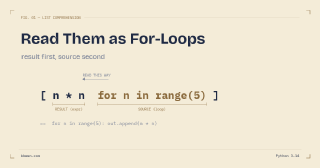
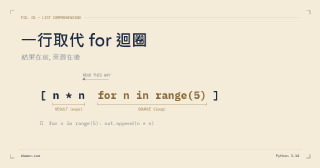
A relaxed take on Python list comprehensions: translate them back into the equivalent for-loop, and check what's actually true about variable leaking and speed on Python 3.14.
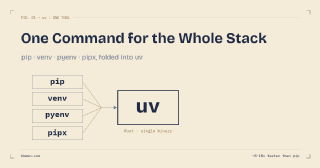
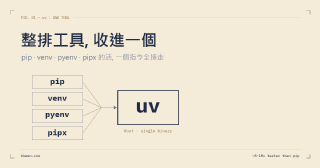
uv is Astral's Rust-written Python tool that folds pip, venv, pyenv, and pipx into one command — and installs packages several times faster. What it replaces, how fast it really is, and whether you should switch.
A relaxed take on Python list comprehensions: translate them back into the equivalent for-loop, and check what's actually true about variable leaking and speed on Python 3.14.
A relaxed take on Python list comprehensions: translate them back into the equivalent for-loop, and check what's actually true about variable leaking and speed on Python 3.14.
uv is Astral's Rust-written Python tool that folds pip, venv, pyenv, and pipx into one command — and installs packages several times faster. What it replaces, how fast it really is, and whether you should switch.
A relaxed take on Python list comprehensions: translate them back into the equivalent for-loop, and check what's actually true about variable leaking and speed on Python 3.14.
uv is Astral's Rust-written Python tool that folds pip, venv, pyenv, and pipx into one command — and installs packages several times faster. What it replaces, how fast it really is, and whether you should switch.
uv is Astral's Rust-written Python tool that folds pip, venv, pyenv, and pipx into one command — and installs packages several times faster. What it replaces, how fast it really is, and whether you should switch.