TL;DR: Your “thank you” to ChatGPT is about two tokens, basically free. What actually costs money is that those two tokens force the model to run a whole fresh round just to reply “You’re welcome!” That round, times billions of messages, is the “tens of millions” Sam Altman was talking about. Does being polite get you better answers? Two serious studies flatly disagree, so there’s no verdict yet.
Back in April 2025, someone asked Sam Altman on X how much money OpenAI has burned on electricity because people type “please” and “thank you” to ChatGPT. His answer: tens of millions of dollars, well spent.
My first reaction was less gracious: so should I stop, then?
I add “thanks” without thinking, even though I know there’s nobody on the other end to feel snubbed. But “tens of millions” made me uneasy, like my reflexive politeness was running up a bill in a data center somewhere. So I did the boring thing and measured it.
Your “thank you” is two tokens
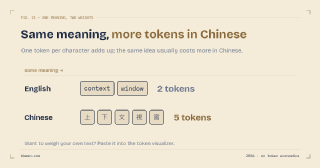
A token is the unit a model reads and gets billed in — roughly, a common short word is one token. I ran a few pleasantries through the tokenizer ChatGPT actually uses (it’s called o200k_base; you can ignore the name):
| What you type | tokens |
|---|---|
| please | 1 |
| thanks | 1 |
| thank you | 2 |
| Thank you! | 3 |
Two tokens. Wrap a plain request in politeness (“Could you please translate this to English for me? Thank you!” instead of “Translate this to English”) and you’ve added about 9 tokens. At list prices that rounds to nothing.
If you want the longer version of how token costs actually behave, I got into that in the token economics post. The point here is narrow: per unit, politeness is free.
So where do the tens of millions come from?
The expensive part is the reply, not the “thanks”
The part that’s easy to miss: when you send a bare “thank you,” you’re not just spending two tokens. You’re making the entire model run again, from scratch, for those two tokens.
It has to re-read your whole conversation (the model re-reads everything each turn; it doesn’t actually “remember” the last message, which I got into in why AI forgets what you said), run a full forward pass, and generate “You’re welcome! Anything else?” back at you. That reply is output tokens (what you type is input, what it writes back is output), and output runs several times the price of input. And what really runs up the bill is the GPU doing a whole round of work.
Altman has put a figure on one round elsewhere: an average ChatGPT query uses about 0.34 watt-hours, roughly an oven running for a second. Trivial once. But your standalone pleasantry forces an extra full query, one carrying no information, pure social reflex. Multiply that by the slice of ChatGPT’s billions of daily messages that are just “thanks” or “you’re a lifesaver,” and you land at tens of millions.
But politeness gets better answers, right?
This was the part I actually wanted to know: if being nice buys better answers, the cost pays for itself.
I went looking, and the research is arguing with itself.
A 2024 cross-lingual study (English, Chinese, Japanese) found that rude prompts do tend to hurt, that being extra polite doesn’t help, and that the sweet spot oddly depends on the language.
Then a 2025 paper flipped it. Rewriting the same questions from “very polite” to “very rude,” they found the rude versions scored slightly higher: 80.8% for very polite, 84.8% for very rude. Small gap, opposite direction. Maybe newer models just react to tone differently than older ones did.
Two serious papers, opposite conclusions. So “being polite makes the AI smarter” is, as far as I can tell, a small and unstable effect with no verdict yet. For now, courtesy isn’t a reliable way to get better answers.
So should you say it?
I measured all this, and I’m still going to type “thank you.”
The reason changed, though. Not because it makes ChatGPT try harder; the evidence isn’t on my side there. It’s more that I’d rather not train myself to bark orders at something that talks back, in case that tone leaks into how I speak to actual people.
If you’re running automation (hundreds of thousands of calls a day), that’s a different world. At that scale, stripping the pleasantries out of every prompt is reasonable; you save on both the tokens and the extra round trips they trigger. That has nothing to do with the “thanks” you type into a chat box. I made the same split in how I actually use these tools day to day: casual use and serious tooling deserve different rules.
So there’s no clean answer. Your “thank you” is cheap, whether it buys a better reply is a mystery, and whether to say it turns out to be a question about the kind of person you want to be.