TL;DR: I keep ChatGPT, Claude, and Gemini all open, and the habits that actually help are pretty boring: send quick lookups to ChatGPT or Gemini and longer/careful work (writing, code, anything that needs nuance) to Claude; spend fifteen seconds giving context before you ask; treat it as a back-and-forth instead of expecting one perfect answer; double-check anything load-bearing, because a confident tone isn’t proof; and don’t cram five requests into one prompt. None of this is deep; it’s just what stuck after using them a while, and it’ll probably shift as the models change.
A friend looked at my screen the other day and asked why I had three different AI chats open, switching between them, wasn’t that confusing? I thought about it, and honestly, it’s just a handful of habits that built up from using them.
Up front: this is all calibrated to the models as they are right now.
Which AI should you use for what?
Honestly, the most useful habit is just having more than one open and roughly knowing which to reach for. I didn’t plan this; I drifted into it. Here’s roughly how I split things:
| What I’m doing | Where I tend to send it |
|---|---|
| Quick lookup, a fast “what’s X”, something throwaway | ChatGPT or Gemini — speed matters, “good enough” is fine |
| Long-form writing, code review, anything needing careful reasoning | Claude — I care more about the quality of thinking than raw speed |
| Stuck / a weird answer | whichever I wasn’t using — re-ask elsewhere |
This split is subjective. You might find the exact opposite works for you, which is completely fine. I think “which one is best” is mostly a dead-end question. The point is that when you’ve got a couple of tools, you usually know which one to reach for, and switching when you’re stuck often just works. A different model phrases things differently, and sometimes that’s all it takes.
Context matters more than clever wording
This is probably the habit that changes the output the most. When I started, I used it like Google: three keywords, hit enter, then felt let down by the bland answer.
The problem there is usually me: the model can’t see what’s in my head. If I just type “write me an intro,” it has nothing to work with, so of course it hands back something generic and four-square.
Now I spend an extra fifteen seconds setting it up: who’s this for, what tone, roughly how long, anything it should avoid. The difference is genuinely noticeable. You just have to let the other side know what you’re actually after before it can land it.
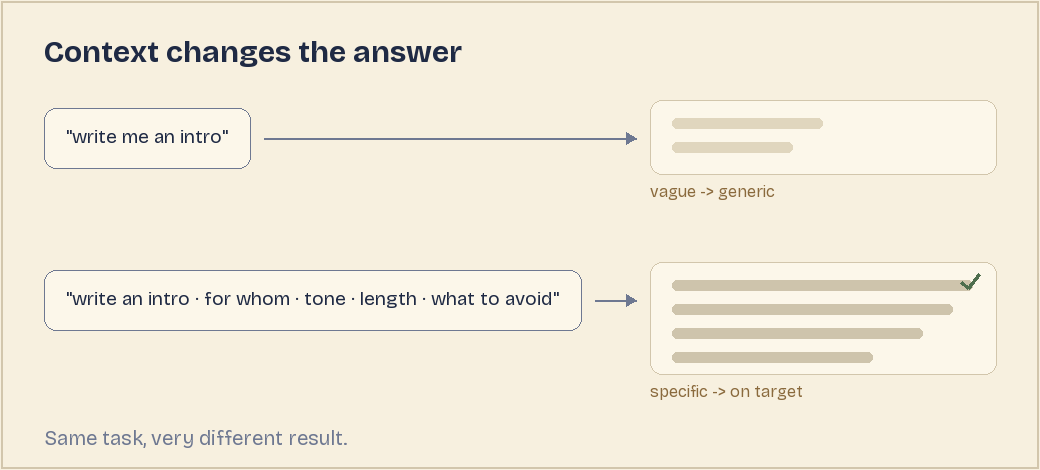
Same request — the amount of context you give changes the result a lot.
Don’t expect a perfect answer on the first try
A good prompt (the text you send it) doesn’t have to hit a bullseye in one shot.
These days I treat it like a conversation rather than a vending machine. The first reply is usually a 70%-there draft, and then I follow up — cut this in half, give an example there, make the tone plainer. Two or three rounds in, it’s usually where I wanted it.
That sounds like more work, but it’s actually less than trying to engineer one giant, perfect prompt up front. Just add things as they occur to you.
Why a confident answer isn’t a correct one
This one I learned the slightly painful way, so it stuck. The trap is that it sounds exactly as sure when it’s wrong as when it’s right. There’s no tell in the tone.
So for anything that matters (a name, a number, a claim I’m going to repeat), I check it myself rather than taking its word. If you want the longer version of why a model can be so fluently, confidently wrong, I wrote a whole separate piece on it: Why Does AI Sound So Confident When It’s Wrong? The short version: it’s optimizing for “sounds right,” not “is right,” and those aren’t the same thing.
Why I don’t bother with fancy prompt templates
To balance all the habits I do keep, here’s one I mostly skip: those “ultimate prompt template, copy-paste to unlock genius” packs. I rarely use them.
Not that they’re useless; they just feel like overkill for everyday questions. I’d rather put that energy into being clear about what I want, which gets me most of the way there with none of the ceremony. (I think the obsession with magic-wording is a bit of a wrong turn, which I got into in what actually separates a skill from a prompt.) If you’re doing something repeatable and need stable output, then yes, fixing your instructions earns its keep, but that’s a tooling concern, separate from the casual day-to-day this post is about.
That’s basically it
Looking back, these are just what grew out of using the things a lot: know which tool to reach for, set up your ask, don’t demand perfection, verify what matters, don’t overload one prompt.
This is all calibrated to the models as they are now, so some of it will probably age out. Until then, this is how I work with them.
One small habit I actually looked into: whether it’s worth saying please and thank you to ChatGPT. The cost is tiny, and the effect on the answer is mixed. If you’ve got your own little habits, I’d love to hear them.
中文版在這裡:我每天開著三個 AI 聊天視窗,這陣子摸出來的幾個小習慣